Webflow Pricing: The Real Cost of Ownership for SaaS Companies in 2026

Adrian KuleszoCo-founder
Table of contents
Webflow’s published pricing is straightforward enough. The actual cost of running a Webflow site for a funded SaaS company is not. There are plan tiers, seat costs, add-ons, the build itself, and ongoing maintenance, none of which show up together in one place. And Webflow restructured its entire plan lineup in May 2026, so a lot of the pricing advice still floating around is now wrong.
We’ve built and maintained Webflow sites for companies including Seamless.AI, N3XT, and GoHighLevel. Here’s how the numbers actually stack up in 2026, with the new structure.
Webflow’s Plan Structure in 2026
Webflow still bills on two separate tracks: a Site plan (hosting and publishing the live site) and Workspace seats (the people working inside Webflow). Most guides only cover one. You pay for both.
Site Plans
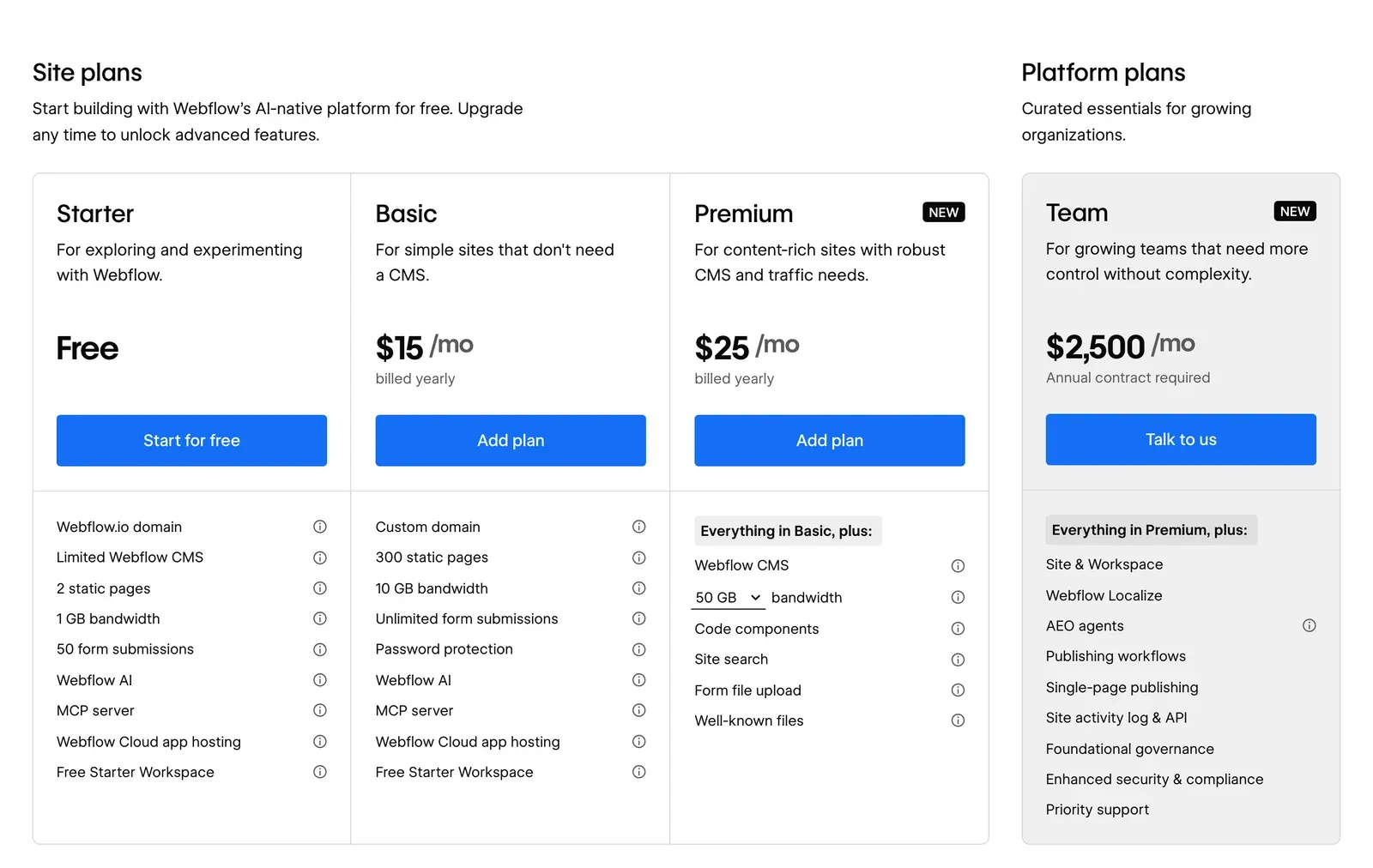
This covers hosting, the CMS, and what your live site can actually do. In May 2026, Webflow collapsed the old four-tier lineup (Basic / CMS / Business) into a simpler set.
Starter: Free. Build and test, but you can’t publish to a custom domain. Fine for prototyping, not production.
Basic: $15/month billed annually ($25 monthly). No CMS. Fine for a static brochure site or a few landing pages, wrong for anything content-driven.
Premium: $25/month billed annually ($39 monthly). This is the plan most B2B SaaS marketing sites actually want. Webflow merged the old CMS and Business plans into this single tier, and it now includes 20,000 CMS items, 40 CMS Collections, and 50GB bandwidth by default, the CMS-item add-ons that used to catch teams out are gone.
Team: $2,500/month, annual contract. An all-in-one plan for organizations that have outgrown self-serve, bundling 10 seats, 100 Collections, localization, and workflow features.
Enterprise: Custom pricing for SSO, advanced security, SLAs, and dedicated support.
For a funded SaaS company actively publishing blog content and case studies, Premium at $25/month is the realistic baseline.
Workspace Seats
This is what your team pays to work inside Webflow, billed separately from the Site plan. Seats come in three types: a Full Seat at $39/month (build and design access), a Limited Seat at $15/month (lighter editing), and a Free Seat at $0 for reviewers who only comment. Every Workspace now includes AI credits.
So the realistic monthly platform cost for a Series A SaaS company: Premium Site plan plus one to three Full Seats, lands around $100 to $250/month. Add-ons like Optimize (A/B testing and personalization, from $299/month) stack on top if you need them. None of this is significant relative to most SaaS operating costs, but it’s worth knowing before you commit.
(Pricing verified June 2026. Webflow adjusts periodically, confirm at webflow.com/pricing before budgeting.)
The Build Cost
Platform fees are the smallest line item. The build is where the real cost sits.
A properly designed and developed Webflow site for a funded B2B SaaS company, one that does real conversion work, has a functioning CMS, is SEO-configured correctly, and reflects the brand accurately, costs between $15,000 and $50,000 to build depending on scope. That’s the floor for work that’s genuinely doing a commercial job; the sub-$15k quotes you’ll see elsewhere are templates and execution-only freelance work, which is a different product for a different kind of company.
The variables:
Page count. A five-page marketing site is a fundamentally different project from a thirty-page site with industry pages, a blog, a resources section, and campaign landing pages. Both are “Webflow sites.”
Design complexity. A template-based build costs less than a fully custom design with sophisticated interactions and a bespoke component library. Both can look excellent, the question is how differentiated the design needs to be from a template.
CMS architecture. Structured collections, blog posts, case studies, integrations, pricing tiers, increase setup and build time. Done well, this pays back in editorial speed for years. Done quickly, it creates debt.
SEO configuration. A Webflow build can be SEO-ready out of the box or completely unoptimised, depending on who’s building it. Meta structures, redirect mapping, schema, canonical tags, and sitemap configuration aren’t automatic.
For context, our standard entry point at DesignMe is a $2,500 UX audit: three to five days in which we audit your site and redesign one piece as proof, credited to any package if you continue. It’s a low-risk way to see the work before committing to a full build. The builds themselves start at $15,000 and run to $50,000+ for Series A through D companies, because that’s what a site doing real commercial work actually takes. For the full picture of what drives these numbers, see our SaaS website design cost breakdown.
If You’re Migrating to Webflow
If you’re moving from WordPress or Framer, the migration is its own project, and this is where I want to correct a mistake I see constantly, including in older versions of pricing guides like this one.
A migration is not a cheap content transfer. A proper one is a rebuild with SEO preservation layered on top: a full audit, a complete 301 redirect map, on-page SEO reproduced deliberately, and post-launch monitoring. For a typical SaaS marketing site that runs six to eight weeks, not a weekend. The only version that takes two to four weeks and a few thousand dollars is a straight port of a small, low-traffic site, and for anything with rankings worth keeping, that’s exactly the version that loses traffic.
We break the full logic down in our website migration cost guide, and the step-by-step process lives in the WordPress to Webflow migration guide. The short version: price the migration as a rebuild, because that’s what protects the asset.
Ongoing Maintenance Costs
A Webflow site isn’t a one-time cost.
Content updates. If your marketing team manages copy and blog posts themselves in Webflow’s Editor, the cost is low, a few hours of training and occasional questions. This is one of Webflow’s genuine advantages over developer-dependent platforms.
Design and development changes. New sections, updated components, restructured pages, these need someone with Designer access. After launch, you have two ways to cover this with us.
The first is an hourly package: 25 hours for $3,000 a month, 50 hours for $5,000 or 100 hours for $9,000, for maintenance and active support once your site is live. One thing to be clear about, because people assume otherwise, this is a monthly arrangement, billed each month, not a one-off bank of hours you buy once and dip into over the following year. It’s the lighter option, for keeping a finished site healthy and moving.
The second is a full retainer, starting at $5,900/month for design or development, $8,900 for both and $11,900 with growth added, a continuous design and development partnership for companies iterating on the site constantly: new landing pages, campaign work, redesigned sections as positioning shifts.
New landing pages. Fast-growing SaaS companies produce a lot of these. Companies that invest in a proper component library upfront ship them faster and cheaper later, and a retainer is usually how they keep that pace.
So your realistic ongoing budget is either an hourly package (from $3,000/month for light maintenance) or a retainer (from $5,900/month for an active partnership), depending on how hard the site is working for you.
Webflow vs. Hiring In-House
For most Series A+ companies, the comparison that actually matters isn’t Webflow vs. another platform, it’s agency retainer vs. in-house hire.
A mid-level Webflow developer with design capability costs $90,000 to $130,000 per year in salary, plus benefits, recruiting fees, management overhead, and gap periods between hires. And one person rarely covers design thinking, development, CMS architecture, and SEO at a high level, that combination is genuinely rare.
A well-run agency retainer, starting at $5,900/month and running to $11,900/month for design, development and growth together, gives you a full team across those disciplines with no overhead. For most companies below around 200 employees, that’s more capital-efficient than an in-house hire. We go deeper on this trade-off in when to hire a design agency vs. an in-house designer.
Hidden Costs Worth Knowing
Third-party integrations. Advanced forms, A/B testing, personalisation, or complex analytics mean tools like Typeform, VWO, Mutiny, or Segment on top, each with its own cost.
Domain registration. Webflow doesn’t include your domain; budget $10 to $20 a year from a registrar.
Training. Webflow University is free but not instant. Factor real ramp-up time if you’re building the capability in-house.
Is Webflow Worth It?
For the companies we work with, funded B2B SaaS, Seed to Series D, yes, consistently. The total cost of ownership depends on how actively you run the site afterward, so here are the two realistic scenarios:
Build plus light maintenance. Initial build $15,000–$50,000, platform fees roughly $1,500–$3,000/year, and an hourly package from $3,000/month ($36,000/year) once you’re live. Year-one total: roughly $52,500–$89,000.
Build plus an active retainer. Same build, same platform fees, plus a retainer from $5,900/month ($70,800/year) for a team iterating on the site continuously. Year-one total: $87,300 and up.
Both are meaningful numbers, and both are less than a full-time senior designer-developer hire ($130,000+ all-in for one person who still can’t cover design, development, CMS, and SEO at a high level), with higher-quality, faster output from a team.
The mistake most companies make isn’t choosing Webflow. It’s underspending on the build and then paying more later to fix what was done cheaply the first time. The brief, the architecture, and the component library you invest in at the start determine how much everything costs afterward.
If you’re still deciding between platforms, see Webflow vs WordPress for SaaS and Webflow vs Framer, and for Framer’s equivalent cost breakdown, our Framer pricing guide.
DesignMe is a Webflow Premium Partner. We build, migrate, and maintain Webflow sites for funded B2B SaaS and AI companies. If you want a direct read on what your project would cost and what it would include, our intro call is 30 minutes: