SaaS Website Design Cost (2026 Breakdown)

Adrian KuleszoCo-founder
Table of contents
If you’ve started asking around about website design for your SaaS, you’ve probably gotten wildly different numbers. One agency quotes $3,000. Another quotes $80,000. A freelancer on Upwork says $500. None of them explain why.
I’ve run DesignMe for a few years now. We’ve completed over 350 projects for funded SaaS and AI companies: Seamless.AI, GoHighLevel, Ethena Labs, N3XT, LSE, and I’ve seen what happens when companies underspend, overspend, and get it right. This is what the numbers actually mean in 2026.
Why the Range Is So Wide
Most pricing guides average together branding studios, Squarespace freelancers, offshore dev shops, and full-service agencies. That’s why you see ranges like “$500 to $100,000” with no useful guidance in between.
SaaS is a different category. Your website has to communicate a complex product to a skeptical buyer, often in under 10 seconds, while competing against well-funded companies who’ve spent heavily on theirs. The design can’t just look good, it has to do conversion work. That raises the floor considerably.
The variation in pricing comes down to three things: who’s doing the work, what’s actually in scope, and how much thinking happens before any design tool gets opened.
The Four Tiers
Tier 1: Freelancers ($1,500 - $8,000)
Most early-stage companies start here. A single designer, often working from a template, who can produce something functional in a few weeks.
The output can be fine. The limitation is that you’re getting execution without strategy. Most freelancers aren’t thinking about your funnel, your sales objections, or your conversion architecture. They’re thinking about layout and aesthetics.
We’ve taken on clients who came from this tier and needed a rebuild six months later. Not because the design was ugly, sometimes it wasn’t, but because the site wasn’t doing any sales work. For a pre-seed company that genuinely just needs something live, a competent freelancer is defensible. Beyond that, it tends to create expensive rework.
Tier 2: Boutique Agencies ($8,000 - $25,000)
The most common price point for Seed to Series A. A small team, usually a designer and developer, with some strategic input upfront.
Quality varies more here than anywhere else in the market. The best boutique agencies produce work that outperforms much more expensive studios. The worst are one person with a Figma license and an outsourced developer. The price alone tells you very little.
We started out competing in this band, against a lot of agencies doing it badly, but as the work and the clients got more serious, our own pricing moved up with them. Today our builds start at $15,000 and we operate at the top of this tier and into the next, because that’s what work doing a real commercial job actually costs. The differentiation was never design quality alone, it was whether we understood what the client was trying to sell, and to whom, before we touched a design tool.
One observation from running 350+ of these: the companies that come in with a clear brief, clear ICP, and clear conversion goal almost always get better outcomes regardless of budget. The brief is underrated, so much so that we wrote a whole guide on how to brief a design agency.
Tier 3: Mid-Market Agencies ($25,000 - $80,000)
Dedicated teams, structured processes, strategy workshops, multiple rounds of iteration. Timelines of eight to sixteen weeks are standard.
This tier makes sense for Series B+ companies, major brand refreshes, or situations where the website is a direct revenue driver and a 5% lift in conversion is worth six figures. Our engagement with N3XT, a next-generation challenger bank, ran across 13 months, involved six designers and two developers, and delivered 300+ application screens, a 100+ component design system, a mobile app, and a full Webflow marketing site. That’s a Tier 3 engagement by scope, not a simple website project.
The risk at this tier is scope creep and timeline drag. A $40,000 engagement that takes six months and requires two extra revision rounds has a real total cost significantly higher than the invoice. Watch for agencies with loose project management.
Tier 4: Enterprise Studios ($80,000+)
Top-tier brand studios with industry awards and recognisable client lists. Timeline is usually six months minimum. Output is often exceptional.
Most SaaS companies don’t need this and shouldn’t pay for it. The premium here is largely for brand prestige, not conversion performance.
What’s Actually Included
Price is almost meaningless without knowing what’s in scope.
Design only: Figma files handed off for your team or a separate developer to build. Cheaper upfront, but you own the risk of development translation. Things get lost. Layouts shift. Interactions disappear.
Design + development: The most common full-service engagement. Design and build delivered together. This is what we do at DesignMe by default, and it’s why what we ship looks like the Figma files.
Copywriting: Often not included unless specified. A surprisingly common source of disappointment. Clients receive a beautiful design and have to fill it with their own copy, often at the last minute.
Strategy / CRO: Some agencies run conversion workshops, review funnel data, or audit your existing site before scoping the new one. Others skip this entirely. The difference in outcomes is significant. We built a full brand discovery process for GoHighLevel before a single pixel was placed, moodboards, direction alignment, iteration rounds, because the visual direction was being decided, not just executed.
Ongoing retainer vs. project: A one-time project delivers a website. A retainer delivers continuous iteration as your product evolves. New landing pages as you add features. Redesigned sections as your positioning shifts. Campaign pages that match your sales motion. For high-growth SaaS, the retainer model almost always produces better results than a single big build that’s slightly out of date the day it launches.
How Retainers Work (and Why the Math Makes Sense)
Retainer-based design has become the standard model for funded SaaS companies, and for good reason.
Our retainers at DesignMe start at $5,900/month for design or development, $8,900/month for both and $11,900/month with growth added. At first glance that sounds significant. Put it next to the alternative and it looks different: a senior product designer in a major market costs $150,000 to $180,000 per year in salary alone, before benefits, management overhead, recruiting fees, and the gap periods between hires. A well-run agency at $5,900 to $11,900/month gives you a full team, broader skillset, and faster output. We lay out that comparison in full in when to hire a design agency vs. an in-house designer.
We also offer a UX audit as a first step: $2,500 for three to five days, in which we audit your brand, site or product and redesign one piece as proof. If it’s not right, keep everything we made. If it is, the $2,500 is credited to any package you continue into. It removes the risk of committing to a long relationship on faith, and it’s a filter, because the companies who take it seriously are the ones who value the work.
One data point shaped how we price. In 2024 we raised our prices, and our average project value moved from around $8K to $14K. Our close rate doubled at the same time. We’ve kept moving upmarket since, and full builds now start at $15,000. The lesson wasn’t that clients don’t care about price, they do, but that underpricing signals something about the quality of the work. The companies we want to work with are looking for an agency worth paying for, not the cheapest option available. If your budget is below that, we’re honestly not the right studio for you yet, and that’s fine.
What Stage Should Pay What
Pre-seed / bootstrapped: Honestly, you’re not the buyer for a studio like ours yet, and you shouldn’t be. Keep it lean: a solid Framer or Webflow template, a good freelancer to customise it, and put your energy into messaging over polish. Under $5,000 is defensible at this stage.
Seed (properly funded): Once you’ve raised real money and the site is a sales asset prospects judge you by, conversion architecture starts to matter. This is where a serious build, $15,000 and up, begins to pay for itself, or where a retainer with a studio that understands B2B SaaS makes sense.
Series A ($5M - $20M raised): Your website is now a sales asset that every prospect visits before a demo call, competing against well-funded companies who’ve invested in theirs. Invest accordingly: $15,000 to $50,000 for a proper build, or a retainer from $5,900/month.
Series B and beyond: Design consistency, design systems, and speed of execution all matter at scale. A retainer with a full-service agency is the cleanest solution, typically $8,000 to $20,000/month depending on volume, often alongside larger project work above $50,000.
| Stage | Budget | Best fit |
|---|---|---|
| Pre-seed / bootstrapped | Under $5,000 | A Framer or Webflow template and a good freelancer |
| Seed (properly funded) | $15,000 and up | A serious build, or a retainer with a B2B SaaS studio |
| Series A ($5M–$20M raised) | $15,000–$50,000, or from $5,900/month | A proper build, or a retainer |
| Series B and beyond | $8,000–$20,000/month | A retainer, often with project work above $50,000 |
The companies we work with have collectively raised over $1.6 billion. Design isn’t decorative at that stage, it’s a commercial function, and it’s priced like one.
The Hidden Costs Most Guides Skip
Revisions beyond scope: Most fixed-price engagements include two to three rounds. Beyond that, you’re paying hourly. Get revision scope in writing upfront.
Content delays: Agencies quote timelines assuming your copy, assets, and approvals arrive on schedule. They rarely do. Every week of delay on the client side costs time on the agency side, and that time gets reallocated.
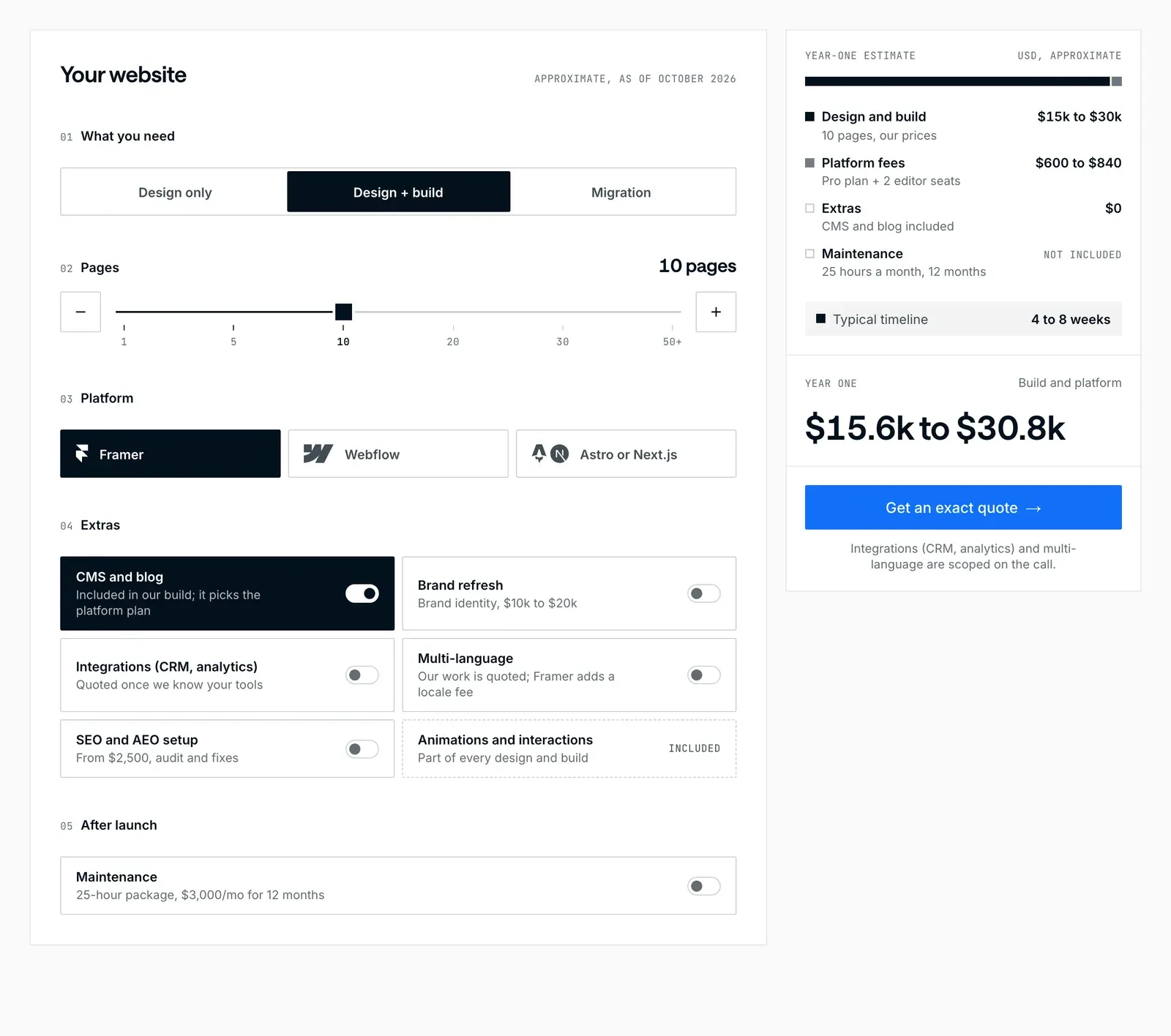
Platform licensing: Webflow, Framer, and similar platforms carry monthly fees. Not expensive, but not zero, our Webflow pricing guide and Framer pricing guide breaks down the real ongoing cost.
Post-launch maintenance: A built website still needs updates. Either you’re on a retainer, or you cover it through a structured support arrangement (ours is an hourly package, from 25 hours for $3,000 a month, billed monthly rather than as a one-off bank of hours). Either way, budget for it; a site nobody maintains drifts out of date fast.
The cost of a weak brief: The single biggest driver of cost overruns is vague scope. Agencies that don’t push back on unclear briefs will build what they assumed you wanted. The rework cost is always higher than getting the brief right upfront.
What to Ask Before Signing
The answers to these questions tell you most of what you need to know before committing.
- Can you show B2B SaaS work specifically, not just general web design portfolios.
- How do you handle conversion strategy before design starts.
- What’s included in revisions, and what triggers additional cost.
- Who owns the files and the platform account when the engagement ends.
- What does post-launch support look like.
If they can’t answer these clearly and specifically, the engagement will reflect that.
The Bottom Line
A realistic budget for a properly designed SaaS marketing site in 2026, for a funded company treating the site as a commercial asset:
- A real, conversion-focused build: $15,000 to $50,000 as a project
- Larger engagements with design systems and multiple templates: $50,000+
- Ongoing partnership: a retainer from $5,900/month, or an hourly package from $3,000/month for lighter post-launch maintenance
Below $15,000 you’re in template-and-freelancer territory. That’s a legitimate choice for a pre-funding company that just needs something live, but it’s a different product, and it’s not what a site competing for funded-buyer attention requires.
The agencies quoting $2,000 for a full SaaS website are either outsourcing everything or treating it as a loss leader. The studios quoting $100,000+ are often selling brand prestige over conversion performance. The work worth paying for sits in between, done by a studio that understands both design craft and how SaaS buyers actually think.
DesignMe works with funded B2B SaaS and AI companies on design and development, from full website builds to ongoing retainers. 350+ projects completed. Clients include Seamless.AI, GoHighLevel, Ethena Labs, N3XT, and LSE. If you want to talk through what your project needs: