Framer Pricing: The Real Cost of Ownership for SaaS and Startups in 2026

Adrian KuleszoCo-founder
Table of contents
We ran designme.agency on Framer for three years before moving it to Astro in October 2026, so I know first-hand what it costs to run one. The published pricing looks simple, simpler than Webflow’s, but the headline number isn’t what a team actually pays, and the build cost dwarfs the subscription either way. Framer also adjusted its seat pricing in May 2026, so some of the older advice is now out of date.
Here’s the honest breakdown of what a Framer site costs in 2026, from a studio that builds on it.
Framer’s Plan Structure in 2026
Framer bills two things separately: the Site plan (per published site) and editor seats (per person editing). The advertised plan price only covers the first. Add both for your real cost.
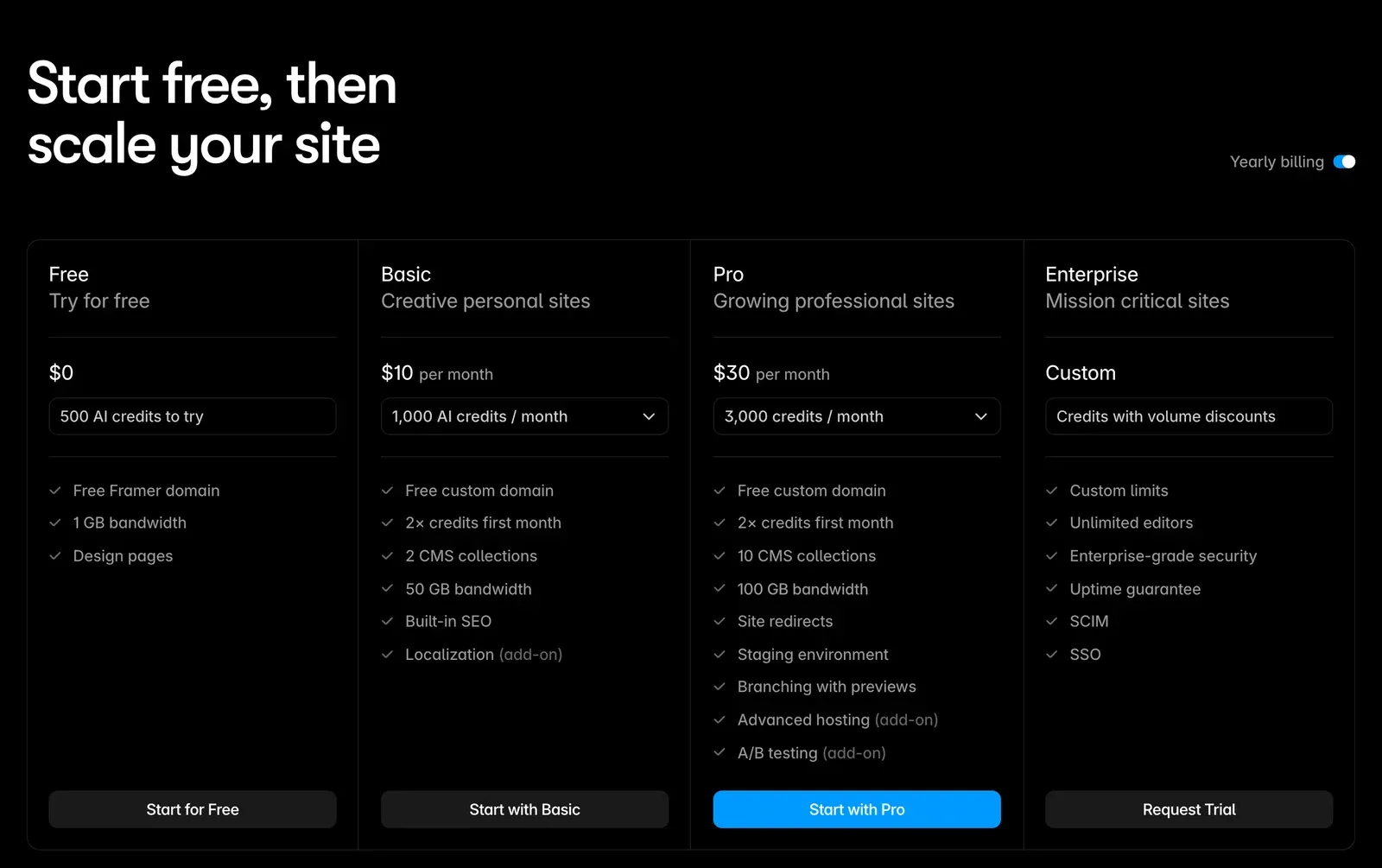
Free: $0. Full editor with AI tools, but publishes only to a Framer subdomain with Framer branding. Genuinely useful for building and testing before you commit, design your whole site on Free, then upgrade to publish on your domain.
Basic: $10/month billed annually ($15 monthly). Connects a custom domain, minimal CMS. Right for portfolios and small marketing sites.
Pro: $30/month billed annually ($45 monthly). 10 CMS collections, staging, advanced analytics, and the features real client work needs. This is the plan most businesses want.
Enterprise: Custom pricing for unlimited seats, custom limits, and dedicated support. Framer no longer lists a Scale plan, so this is the step up for high-traffic sites and large content operations that outgrow Pro, whose page, CMS and bandwidth limits can be extended with paid add-ons up to a cap. Most sites don’t need it, if you’re wondering whether you do, you probably don’t yet.
| Plan | Billed annually | Billed monthly | Right for |
|---|---|---|---|
| Free | $0 | $0 | Building and testing on a Framer subdomain |
| Basic | $10/month | $15/month | Portfolios and small marketing sites |
| Pro | $30/month | $45/month | Most business sites: 10 CMS collections, staging |
| Enterprise | Custom | Custom | Sites that outgrow Pro: unlimited seats, custom limits |
Editor Seats
This is the part the headline price hides. Each person editing pays for a seat on top of the Site plan. As of May 2026, Framer cut editor seats to $20 per editor per month on every plan (down from $40 on Pro), and added a Content Editor seat at $10/month for people who only need CMS editing rather than full design access.
One genuinely useful detail: if you work with a certified Framer expert, their editor seat on your project is free, so partnering with a studio doesn’t cost you a seat.
So a realistic cost for a small team: Pro at $30/month plus a couple of editor seats lands around $70–$110/month, not the $30 headline. Locales (for multilingual sites) are billed separately at around $20 each. Your domain isn’t included, budget $10 to $20 a year.
(Pricing verified October 2026. Framer adjusts periodically, confirm at framer.com/pricing before budgeting.)
The Build Cost
As with any platform, the subscription is the smallest line item. The build is where the real money sits.
A well-designed Framer site for a funded startup or SaaS company runs in the same range as a comparable Webflow build, $15,000 to $50,000 depending on scope, design complexity, and how custom the motion is. Framer’s speed of build helps the timeline, not the price floor: a site that’s genuinely doing commercial work, custom design, a real CMS, proper SEO, is a real project regardless of platform. The cheaper end of the market is templates and execution-only freelance work, which is a different product for a different kind of company.
The same variables drive it: page count, how custom the design and motion are, CMS architecture, and whether SEO is configured properly or left to chance. We break the full logic down in our SaaS website design cost breakdown, and the principles apply directly to Framer.
Where Framer Saves You Money, and Where It Doesn’t
Framer’s real cost advantage isn’t the subscription. It’s maintenance and speed.
Because Framer is fast to build in and a marketer or designer can ship without a developer, the ongoing cost of running a Framer site is often lower than the equivalent on a developer-dependent stack. No plugin maintenance, no security patching, fast iteration. For a lean team, that’s hours back every month and a site that keeps pace with your positioning.
Where it doesn’t save you: if your needs outgrow what Framer is built for, a large, complex content operation, heavy backend, deep integrations, you’ll either pay for workarounds or end up migrating to something with a more powerful CMS. Choosing Framer when you should have chosen Webflow costs more than the price difference, because you pay it twice. We compare the two directly in Webflow vs Framer.
Framer vs. Hiring In-House
For most early and growth-stage companies, the comparison that matters isn’t Framer vs. another platform, it’s whether to run the site through an agency or hire someone.
A senior designer who can build in Framer costs $90,000 to $150,000+ a year in salary, before benefits, recruiting, and management overhead. A retainer with a studio, starting at $5,900/month and running to $11,900/month for design, development and growth together, gives you design, build, and strategy as a team, with faster output and no overhead. For most companies below a certain size, the retainer is more capital-efficient, and the gap is even starker for Framer specifically, since its speed means a good team ships a lot for the spend. We go deeper on the trade-off in when to hire a design agency vs. an in-house designer.
If You’re Migrating to Framer
If you’re moving to Framer from WordPress, the migration is its own project, and like any migration, the cost lives in doing it properly, not in the platform fee. A real migration is a rebuild with SEO preservation built in: a full audit, a complete 301 redirect map, on-page SEO carried over, and post-launch monitoring. The step-by-step is in our WordPress to Framer migration guide, and the cost framing is in the website migration cost guide.
If you’re still deciding whether Framer is even the right destination, Framer vs WordPress covers who it suits, and the Webflow or Framer decision guide compares the two paths.
What We Learned Moving Our Own Site Off Framer
Leaving is part of the cost of owning a Framer site, so here’s what our own move to Astro involved. Framer doesn’t offer HTML export for self-hosting, so moving off it means a rebuild, and most of the work is getting your content and files out in a form you can build on. We kept all 63 live URLs on the same path and moved 1,378 images and files off Framer’s CDN. On the homepage, the first load went from 54MB on the live Framer site to 2.67MB on the Astro staging build.
- 63 live URLs, all kept on the same path
- 1,378 images and files moved off Framer’s CDN
- 54MB → 2.67MB homepage first load, Framer vs Astro staging build
Four things we’d tell anyone planning the same move:
- The CMS export only covers collections. Our 5 CMS collections came out as CSV. Our case studies were built as static pages, so their copy came from the saved HTML of each live page instead.
- Your files live on Framer’s CDN. Images and videos are served from framerusercontent.com, and those URLs stop working when the Framer plan ends. Download every one, serve it from your own host, and search the new build for framerusercontent.com before you cancel.
- The sitemap isn’t the full list of pages. Framer’s sitemap was missing a page our own navigation linked to. Crawl the site as well, or that page quietly disappears in the move.
- The redirect map is bigger than the site. Our 63 live URLs became 116 rows once we added Framer’s own redirects, hidden pages and short links from old articles: 65 keep their path, 43 get a 301 and 8 are retired.
What we got for it: the site is now plain files in a repository, more than 200 pages built from code, and we edit it with Claude through pull requests that someone on the team approves before anything goes live. If you’re weighing the same move, Framer to Astro has the full method.
Is Framer Worth It?
For the right company, a startup or SaaS team whose site is a design-forward marketing asset, run by a lean team that values speed: Framer is excellent value. The platform cost is low, the maintenance burden is minimal, and a small team can keep a genuinely impressive site moving without a developer in the loop.
The honest caveat is the same one that applies to every platform: don’t underspend on the build to save on a subscription that’s a rounding error anyway. The site is the asset. The $30-a-month plan is not where your decision should be made.
For the Webflow equivalent of this breakdown, see our Webflow pricing guide.
DesignMe builds and migrates Framer sites for funded startups and B2B SaaS companies, we ran our own site on Framer for three years before moving it to Astro, so we know exactly what it costs to run one well. If you want a direct read on what your project would cost, our intro call is 30 minutes: