When to Hire a Design Agency vs. an In-House Designer

Adrian KuleszoCo-founder
Table of contents
This is the decision most founders and product leaders get wrong, usually in one of two directions. They hire an in-house designer too early, before they have enough consistent work to justify the overhead, and spend six months managing someone who’s underutilised and increasingly frustrated. Or they stay with an agency too long past the point where embedded context and product depth would serve them better than external flexibility.
I run DesignMe, a design and development agency working with funded B2B SaaS and AI companies. I have an obvious incentive to tell you agencies are always the right answer. They’re not. Here’s an honest version of how to make the decision.
What You’re Actually Choosing Between
An in-house designer is an employee. They’re embedded in your product, your team, and your culture. They accumulate context over time. They’re available for ad hoc requests. They care about the product because it’s theirs.
An agency is a team. They bring broader skillsets, faster ramp-up, more design volume at equivalent cost, and no hiring overhead. They don’t accumulate context at the same rate, and they’re not available at 9pm when something breaks.
Neither is categorically better. The right answer depends on where you are, how much design work you consistently have, and what kind of design work it is.
| What matters | Agency | In-house designer |
|---|---|---|
| Best stage | Seed to Series B, and fundraise or launch moments | Past Series B with a stable design scope |
| Kind of work | Bursty and varied: brand, product, web, pitch decks | Consistent, product-focused, needs deep context |
| Cost | Retainer from $5,900/month for a team | $160,000 to $220,000 a year all-in for one person |
| Context | Needs good briefs to close the gap | Builds up over time |
| Availability | Within scoped engagements | On demand for ad hoc requests |
The Case for an Agency
You’re Pre-Series A and Design Isn’t Your Primary Bottleneck
Before Series A, most companies don’t have consistent, predictable design work. There are intense bursts, a fundraise, a product launch, a website rebuild, followed by quieter periods. Hiring a full-time designer for burst demand means paying a full-time salary for part-time output between bursts.
An agency scales with demand. You pay for what you use. You get a team with the breadth to handle whatever the burst requires, brand, product, web, pitch deck, rather than one person who’s strong in one area and stretched in others.
You Need Breadth More Than Depth
Early-stage design work is varied. One week it’s the marketing site. The next it’s the product onboarding flow. The next it’s investor materials. Hiring a designer who’s excellent at product UX means compromising on brand and web work. Hiring for brand means compromising on product. A good agency has all of these skills in-house and deploys them based on what the brief requires.
The N3XT engagement is a reasonable example. Over 13 months, the work covered brand strategy, a 100+ component design system, 300+ product screens, a mobile application, a Webflow marketing site, and investor materials. That’s six different design disciplines. No single in-house hire covers all of them at a high level.
You’re About to Do Something Significant
Fundraising, a major rebrand, a product launch, a new market entry. These are moments where design quality matters more than usual and the timeline is fixed. Agencies can ramp up for these moments in ways that hiring can’t, you can’t recruit, onboard, and get a designer up to speed fast enough to hit a pitch deadline six weeks out.
We’ve taken on clients specifically for fundraise moments, companies that needed their brand, deck, and website to look like a Series B company before the round closed. That’s not a permanent headcount decision. It’s a time-bounded, high-stakes engagement where external capacity makes sense.
Your Budget Is Sub-$150,000 Annually for Design
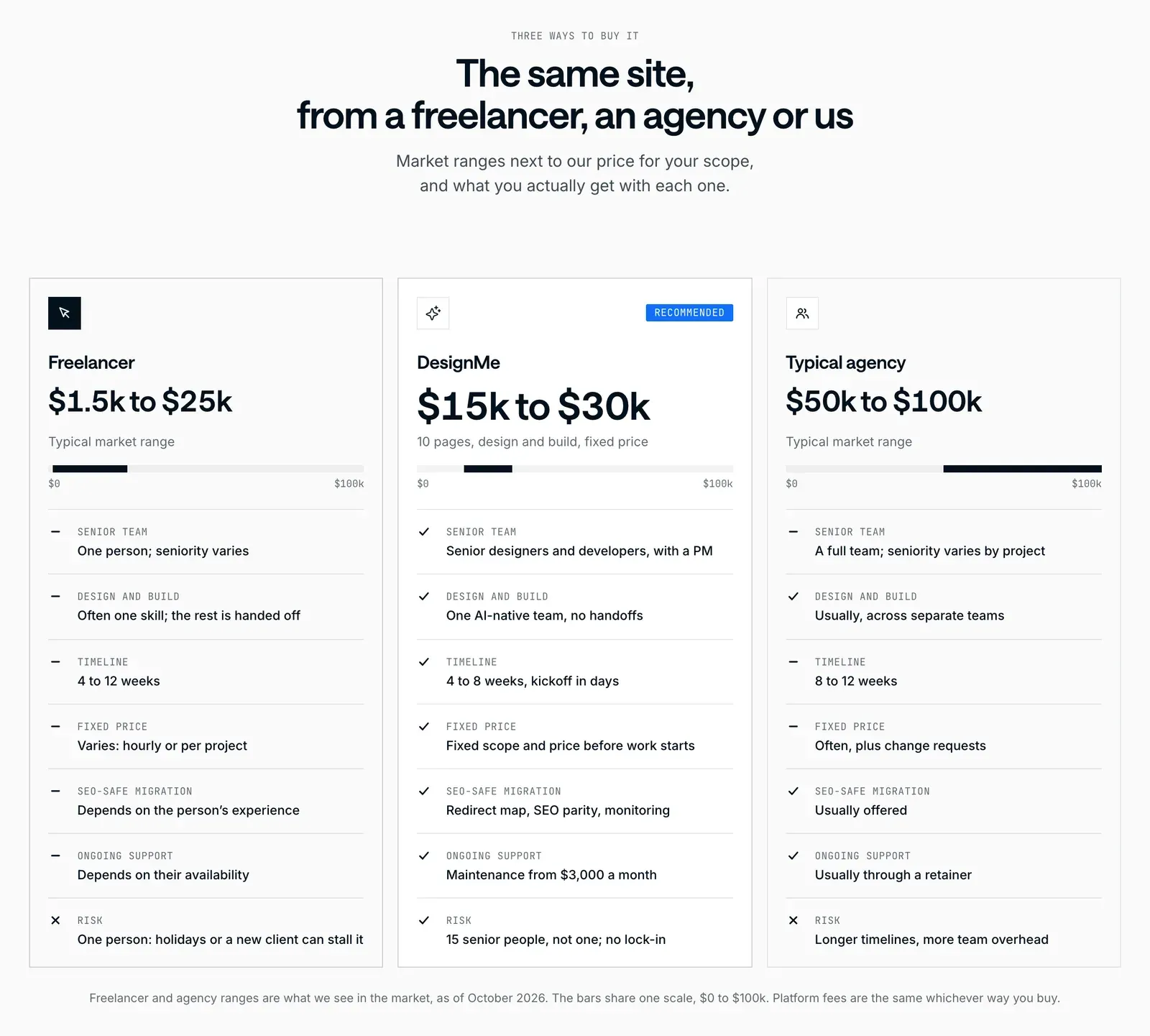
A senior product designer in London, New York, or San Francisco costs $130,000 to $180,000 per year in salary. Before benefits, employer taxes, recruiting fees (typically 15-20% of first-year salary), equipment, and the inevitable gap between hires, the real cost of a single in-house designer is closer to $160,000 to $220,000 per year.
A DesignMe retainer starts at $5,900/month for design or development, $8,900 for both and $11,900 with growth added, and gives you a team across design, development, and strategy rather than one person. Below the spend level where a strong senior hire makes sense, the economics almost always favour an agency. For the full breakdown of how that maths works against a specific platform build, see our Webflow pricing and cost-of-ownership guide.
The Case for In-House
You Have Consistent, Predictable Design Volume
If your design backlog is never empty, if you have more ongoing product work than you can get through, and that work requires deep product context, hiring makes sense. An agency relationship requires good briefs and clear communication to compensate for the context gap. When work is continuous and deeply embedded in the product, an in-house designer who attends standups, reads Slack, and understands the roadmap closes that gap naturally.
Your Product Is the Design
If design is the core differentiator of what you’re building, a consumer app where the experience is the product, a tool where the UI is what users pay for, you probably want design embedded in the team from early on. The iteration speed and contextual depth that comes from an in-house designer who’s in every product conversation is genuinely hard to replicate externally.
You’re Past Series B With a Stable Design Scope
At scale, the economics shift. The coordination overhead of managing an agency relationship adds friction that becomes meaningful when you’re moving fast. And at Series B and beyond, you can afford to hire well and retain well. The cost gap narrows, the context advantage of in-house grows, and the calculus changes.
Most companies we work with at Series B are either supplementing an in-house team (using us for overflow, campaigns, or specific projects) or transitioning from us to building out their own design function. Both are legitimate outcomes of a well-run agency relationship.
You Need Someone Available on Demand
Agencies work within scoped engagements. We’re not monitoring Slack at 10pm for a spontaneous request. In-house designers are available in ways agencies aren’t, for quick questions, ad hoc iterations, and the general low-level design support that a product team relies on day-to-day.
If that availability is critical to how your team works, and you have enough consistent volume to justify the headcount, hire.
The Hybrid Model
The answer most growing companies land on eventually is both.
A lean in-house design function, one or two designers embedded in the product team for ongoing product work, supplemented by an agency for web, brand, campaigns, and high-volume production work. The in-house team provides context and availability. The agency provides scale, breadth, and quality on work that falls outside the in-house team’s bandwidth.
Several of our longest-running clients operate this way. They have a product designer or design lead in-house and come to DesignMe for marketing site work, campaign pages, rebrands, and design system development. It’s not a handoff, it’s an ongoing parallel relationship where each side does what it does best.
The Signals That Tell You It’s Time to Hire
If all of the following are true, in-house probably makes sense:
- You have consistent design work with no meaningful gaps in the backlog
- The work is primarily product-focused and requires deep context
- You’re spending more than $150,000 annually on agency work
- Your product is at a stage where design iteration speed is a competitive advantage
- You can attract and retain a strong designer at your current stage and location
If most of these aren’t true yet, an agency relationship is almost certainly more capital-efficient.
What to Watch Out For
Hiring too junior to save money. A junior in-house designer is less capable than a senior one, but they still require the same management overhead and create the same dependency. The cost saving relative to an agency is smaller than it looks, and the output gap is significant.
Assuming agency means slow. The agencies worth working with operate fast. Our standard trial engagement delivers real work in two weeks. The slowness associated with agencies usually comes from poor briefing and approval cycles, not agency capacity, which is exactly why a clear brief matters so much.
Treating the decision as permanent. Most companies cycle through different models as they grow. Starting with an agency, transitioning to hybrid, eventually building in-house is a common and sensible progression. The decision today doesn’t have to be the decision in two years.
- Agency Bursty, varied work before Series A, with no hiring overhead.
- Hybrid One or two designers in-house, an agency for web, brand and campaigns.
- In-house Consistent product work, and agency spend past $150,000 a year.
One more thing worth factoring in for 2026: AI has widened the gap between strong and mediocre designers rather than closing it, which changes the in-house calculus in ways that aren’t obvious. We unpack that in AI in product design in 2026.
The Honest Version
If you’re a funded B2B SaaS company between Seed and Series B, reading this because you’re trying to figure out how to handle design, the agency model is probably right for where you are. Not because I’m biased, I am, but that’s not why, but because the economics, flexibility, and breadth advantages are real at your stage, and the context disadvantage is manageable with good process.
When that stops being true, you’ll know. The work will be more than an agency can absorb cleanly, the product will need design thinking that’s fully embedded, and the headcount spend will be justified by consistent output. Hire then.
For a fuller picture of what agency work actually costs at each stage, see our SaaS website design cost breakdown.
DesignMe works with funded B2B SaaS and AI companies from Seed to Series D on design and development. If you’re trying to figure out the right model for your stage, the intro call is a good place to start, no obligation to do anything other than get a straight answer: