The Pitch Deck Slides Investors Expect at Seed and Series A in 2026

Adrian KuleszoCo-founder
Table of contents
The slide list hasn’t changed much in a decade. Sequoia’s guide to writing a business plan still lists the same ten sections most decks follow: company purpose, problem, solution, why now, market, competition, business model, team, financials and vision.
What changes between seed and Series A is what each slide has to prove. We design decks for founders at both stages, and this is the list we work from, with what each slide needs at each one.
The slides, in order
| Slide | At seed, it has to show | At Series A, it has to show |
|---|---|---|
| Title | What you do in one line | The same line, now with a number in it |
| Problem | Who has it and why it hurts | That the pain is proven by customers who pay |
| Why now | What changed in the market or technology | Why the window is still open and you are ahead in it |
| Product | What it does, shown, not described | What customers use most and what ships next |
| Market | Who buys and how many of them there are | The segment you win today and the next one |
| Traction | Early signal: pilots, waitlist, first revenue | Growth over time, retention and revenue quality |
| Business model | How you charge and roughly what | Unit economics: margin, payback, expansion |
| Competition | The alternatives buyers use today | Why you win deals, with evidence |
| Go-to-market | How you’ll reach the first customers | The motion that repeats and what it costs |
| Team | Why these people for this problem | The leaders you have and the hires you need |
| The ask | Amount, runway and milestones | Amount, use of funds and the next round’s milestones |
| Vision | Where this goes if it works | The same, backed by what the last round delivered |
The order matters more than the exact list. Problem, why now, what you do, proof, then the ask. Most decks open with what the company does before the reader cares why it matters.
- Problem Who has it and why it hurts.
- Why now What changed in the market or technology.
- What you do The product, shown, not described.
- Proof Early signal at seed, growth over time at Series A.
- The ask Amount, runway and milestones, written as a plan.
What seed investors look for
At seed there often isn’t much revenue, so investors are judging the team, the problem and the speed of learning. The first five slides do most of the work.
Make the problem concrete. Show who is involved, what they do today and where it breaks. A simple diagram of a messy process says more than five bullets.
Show early signal, honestly. Pilots, letters of intent, a waitlist, design partners, first revenue or usage. For a hardware or industrial company that might be a paid pilot or a signed distributor. For a DTC brand it might be repeat purchase rate from the first batch. Label it for what it is.
Explain the team in one line each. Under each name, write the one thing that person has done that makes them right for this company.
Write the ask as a plan. “Raising $3M” is half a slide. Add the months of runway, the hires and what ships by when.
What changes at Series A
A Series A deck gets forwarded to partners who were never on the call, so it has to work on its own, in an email and on a phone. And every claim needs evidence.
Traction becomes growth over time. Show monthly or quarterly revenue, not cumulative totals. As a16z points out, cumulative charts always go up and to the right, even when a business is shrinking.
Retention gets its own slide. Retention by cohort shows whether customers stay and expand. If you show net revenue retention, show gross churn as well, since expansion can hide customers leaving.
Unit economics move into the main deck. Gross margin, payback and customer acquisition cost. Investors care more about paid acquisition cost than a blended number that mixes in free channels.
Go-to-market has to repeat. One founder closing deals by hand is a seed story. A Series A story shows a motion others can run: who sells, to whom, how long it takes and what it costs.
Use the right words. Bookings, revenue and ARR mean different things. ARR excludes one-time fees and services, and mixing the terms is one of the fastest ways to lose a reader’s trust.
Build it to be read
Most decks are read before they’re presented. DocSend’s research says investors spend less than three minutes on a deck, so the reader decides quickly whether to take a meeting.
Three habits help. Write each slide headline as the point, so someone reading only the headlines gets the argument. Put one idea on each slide, which is the core of Y Combinator’s design advice for decks: legible, simple and obvious. And show data as charts with labelled axes, because nobody reads twenty rows of numbers on a slide.
Keep detail in an appendix: cohort tables, the financial model summary, product screens, case studies and the cap table if asked. Investors who want depth will find it, and the main deck stays short.
Match the deck to the rest of the company
An investor reads the deck, then opens the website, then looks at the product. When the three look like three different companies, trust drops before the first call. If your raise is close and the brand no longer fits the company, we cover when that’s worth fixing in rebranding before a Series A.
Check your deck
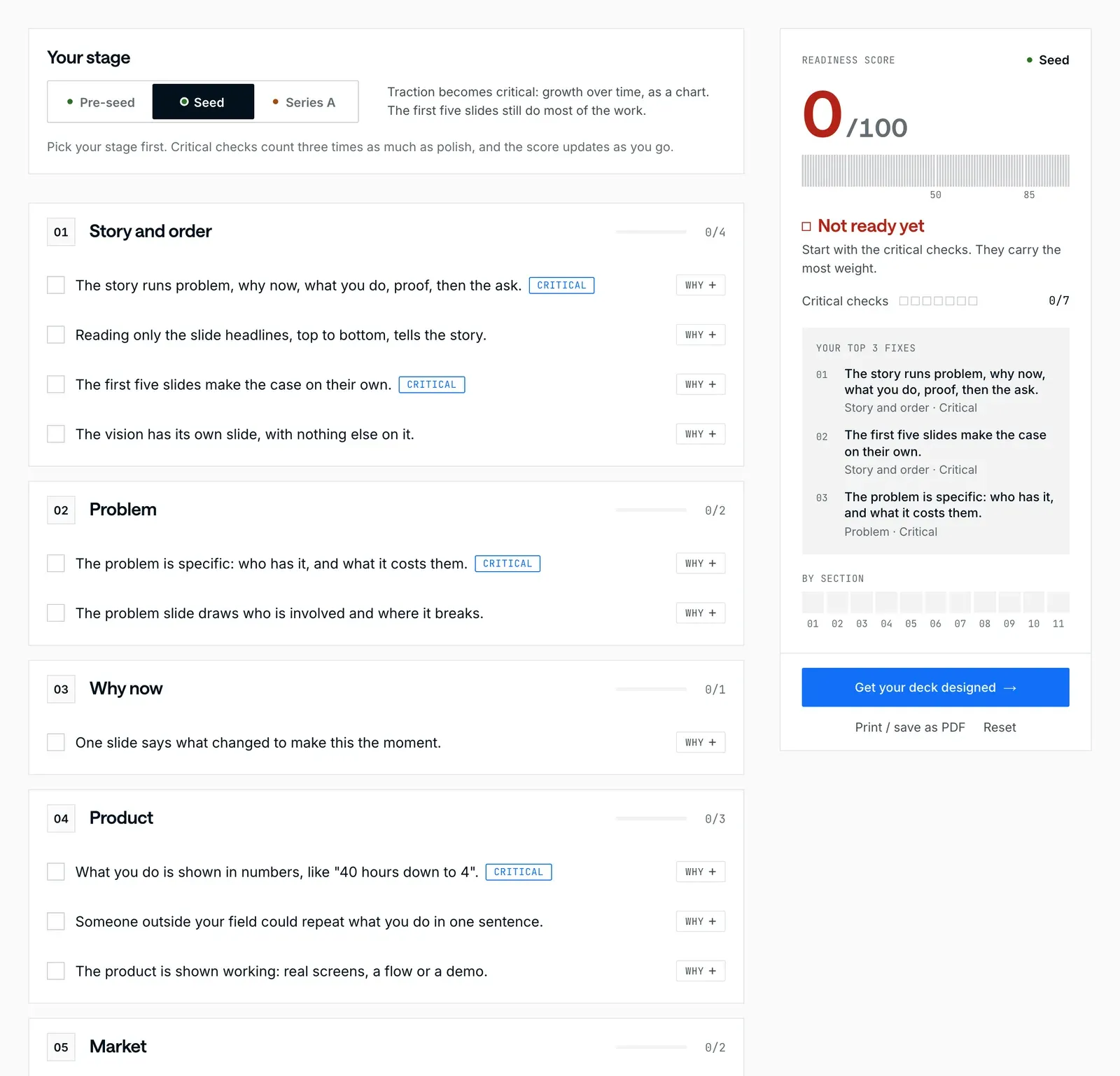
Our free pitch deck checklist walks through each section for pre-seed, seed or Series A, gives your deck a readiness score and lists the three fixes that matter most for your stage. Nothing you tick leaves your browser.
If you’d rather have it designed, our pitch deck design service usually takes 1 to 2 weeks. Early-stage decks run $2,500 to $5,000 and Series A decks $5,000 to $10,000, and the pitch deck pricing guide explains what moves the price. You get the deck in Keynote, Google Slides or Figma, plus a PDF for sending.
We’ve designed decks for teams including N3XT, Datawizz, Lightdash, Quotient, RecruitU and Zinq AI, and founders we designed decks for have raised over $100M between them. The rounds, with sources, are on our fundraising page. The raise is always the founders’ own work. A clear deck gets read properly and makes the next meeting easier to win.
DesignMe designs pitch decks, brands and websites for funded startups at seed and Series A. If you have a raise coming up, send us your current deck and we’ll reply within one business day with what we’d change, or book a 30-minute call with Adrian:
Sources
- Sequoia Capital, "Writing a business plan" (accessed 10 October 2026) (opens in a new tab)sequoiacap.com
- Kevin Hale, Y Combinator, "How to design a better pitch deck" (15 November 2015) (opens in a new tab)ycombinator.com
- Jeff Jordan, Anu Hariharan, Frank Chen and Preethi Kasireddy, a16z, "16 startup metrics" (21 August 2015) (opens in a new tab)a16z.com
- Dropbox DocSend, "Pitch deck research" (published 1 April 2025) (opens in a new tab)dropbox.com
Press Escape to close.